
The Cost of Writing is Too Damn High
About my rewriting PTSD and how I plan to fix it

Want the quick-hit version of this essay? Check out my YouTube short on the same topic.
I’m an idea junkie. I’m addicted to ideating. Recently, I’ve been capturing ideas on the creative process because that’s what I’m struggling with most.
I connect dots, follow threads, think deeply—but if I don’t crystallize an idea through the process of writing, the insight dies with that fleeting flashbang moment of inspiration.
I’m left with fading sparks of excitement that never get fully articulated. Half-baked insights that sit slouching on my idea board.
BTW, here’s my idea board if you want to see inside the mind of a madman:
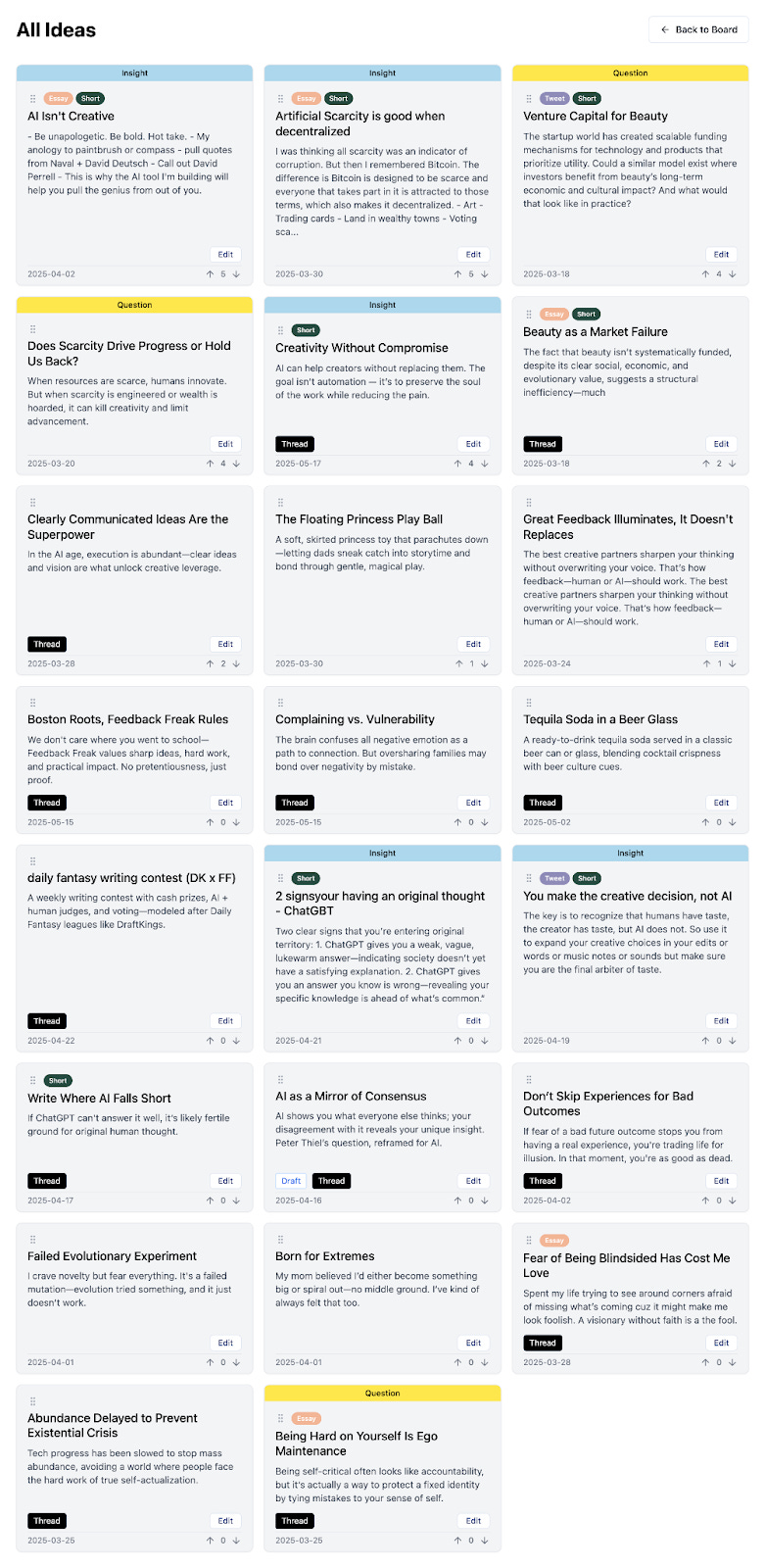
(If you're an Idea Junkie too, and want this tool, tell me here)
The spark for this essay came from the realization that I haven’t published an essay in 10 months.
I’ve captured hundreds of ideas. I’ve turned many into drafts. But there they sit, lonely in my Google Docs, awaiting my return.
Why? What’s stopping me from finishing these drafts?
My best guess is I’ve built up an unconscious avoidance to the excruciating process of writing,
and then rewrite,
and re-re-re-re-re-write,
my last published essay (Coming out of the closet as Artsy). I’m not exaggerating – it probably took me 80+ hours to go from rough draft to published essay.
It didn’t seem too painful in the moment, but my lack of publishing since tells me that it was, in fact, quite painful.
My core idea changed maybe seven or eight times. Sometimes, the core idea would change after I had polished the entire essay with three coats of wax, so to speak. I would insert personal stories to illuminate a subpoint, change wording so I sounded way more poetic than I actually am, or juice the narrative with a turn of phrases or punny jokes to keep the reader engaged…
…But then my trusted editor would give me feedback saying “Cut this entire section” or “Looks like you have 3 or 4 core ideas in this essay, it’s confusing, pick one.”
I’d kick and scream, and try to convince myself I could keep everything, but I knew he was right.
So I had to kill off my darlings. Those sentences, stories, and funny little bits I had worked so hard to produce didn’t belong anymore. Goddamnit. I’d put them at the bottom of the Doc in the “scraps” section, but we all know nothing ever makes it out of there once it goes in.
The cost of rewriting is just too damn high.
So why write?
Well, the payoff is undeniable.
(I don’t write with hopes of going viral, although hitting publish into one of these app algos does feel like pulling the lever on a slot machine, which makes it pretty enticing.)
But it’s not about external validation. It’s about turning a spark of inspiration into a fully articulated idea that’s clear and concise enough for my future self to remember and use. A secondary benefit is if others find it useful too, but that’s unpredictable and out of my control.
Thinking clearly is the intrinsic reward I can rely on.
Like in the process of rewriting “Coming out of the closet as Artsy,” I literally rewired the way I think about a painful part of my past.
Before writing: “I got fired because the management team conspired to ruin my life.”
After writing: “I got fired because I was a drag on team morale > because I was miserable at work > because I was bored out of my mind > because my job had become creatively unfulfilling and therefore dull > because I’m kinda artsy and need to be creatively engaged to be happy.”
Wow! That’s a much clearer view of history—and, as often is the case with clarity, a more optimistic one too.
Before writing: My world can get turned upside down at any moment by malevolent authority figures.
After writing: The world has a way of alleviating what’s making me miserable.
So, I still got the reward of clearer thinking that rewriting always delivers—but the effort to get there was so high that my brain silently stopped me from doing it again.
I have re-writing PTSD.
Maybe it’s an inevitable part of the process.
“To write well you have to think clearly, and thinking clearly is hard.” - Paul Graham
But does it have to be THIS hard?
How can I lower the cost (of re-writing) and still get the benefit (of thinking clearly)?
Editors can help.
But that can sometimes add additional voices when I already have enough in my own head.
I’ve tried dumping my thoughts into AI tools that are supposed to be able to write the essay for you, but it just turns my thoughts into a middle and muddled lukewarm mess. Zero clarity. Just frustration and anger as I read its pretty, well-organized, yucky-bland words.
I thought it was my perfectionism—whose unrealistic expectations lead to procrastination, and then, yano, depression.
But perfectionism isn’t the enemy here; it’s just a sequencing problem.
How I wrote my last essay:
Write a messy first draft exploring a question, insight, or story1
Polish every sentence
Realize it’s actually five half-baked essays in one
Go through hell cutting polished sentences & paragraphs that didn’t fit
Cry myself to sleep thinking about the hours I wasted
Finally publish… but feel completely drained
It’s as if I were a furniture maker who sands and polishes every piece of wood before measuring or cutting anything...
...I eventually finished the table or chair or desk or whatever, but I spent 10x the effort that was required.
The juice is not worth the squeeze.
Cut first, polish later.
I was doing the opposite; most writers I work with do the same.
And when I polish before cutting?
I waste time.
I get emotionally attached to words I've written that don’t belong and then I stop writing altogether.
How I’ll write my next essay:
Write a rough, messy, exploratory draft
Ask ChatGPT to find my top 3 core ideas2
Pick one
Cut everything that doesn’t serve it
THEN polish what’s left
Publish feeling energized and ready to write the next one
LLMs are the perfect tool for this. They’re amazing at compressing, organizing and filtering existing information. Who better to help you find your core idea? And then to find what doesn’t belong to that core idea?
Warning - you have to remember that LLMs have no taste. Yes, it can illuminate potential candidates for your core idea (or climax candidates if you’re wrtiting a story), but ultimately, you are the only one who will know which is most exciting and radiant.
You find your core idea just with your own mind of course, but that’s like trying to navigate the oceans by stars instead of using a compass. You’ll probably still get to where you want to go, it’ll just be a lot harder and take a lot longer.
Use the compass — it’s just a tool, and like any other, it can point the way, but only you can decide where the destination is.
Choose the core idea that is jumping to get out of you. The one that excites you most.
Cut everything else and then polish.
I’m writing again — but this time there will be no rewrite hangover.
If you’re curious, I built a tool called the “Core Idea Identifier.” Drop your draft in and see what it surfaces. Let me know how it goes.
Thank you
for the feedback and encouragement to add more emotion and storytelling to this idea.Paul Graham- The key to writing something interesting is to start with a puzzling question and explore your gaps in understanding. “You don't need to have a complete thesis; you just need some kind of gap you can explore. In fact, merely having questions about something other people take for granted can be edge enough.”
I built this “Core Idea Identifier.” If you have a draft you're working on, put it in and see if it returns something helpful. Let me know how it goes.
…dude you should embed the YT video here too as a pod…also fwiw always liking talking in digital irl…and if we were to meet there fwiw I would ask at this point what would it take you to make the next 10 months 10x this output?…
Super relatable. Glad to see you finally hit publish again though! If you haven't already read the War of Art by Steven Pressfield, I'd highly recommend. Sounds like a classic case of The Resistance. Speaking of which, I should re-read it myself. I'm overdue to publish now as well. It's much harder than it seems.